Saturday, 23 January 2021
Solving Distinct Values Queries using Mo's Algorithm (Query SQRT Decomposition) with Hilbert Curve
## SQRT Decomposition
Square Root Decomposition is an technique optimizating common operations in time complexity O(sqrt(N)). The idea of this technique is to decompose the array into small blocks of size [N / sqrt(N)] = [sqrt(N)].
```cpp
b[0] : x[0], x[1], ..., x[block_size - 1]
b[1] : x[block_size], ..., x[2 * block_size - 1]
...
b[block_size - 1] : x[(block_size - 1) * block_size], ..., x[N - 1]
```
and precompute the answer for all blocks. Example: precalculate the sum of elements in block k.
```cpp
b[k] = min(N - 1, (k + 1) * block_size - 1) Σ i = k * block_size (x[i])
```
To calculate the sum of elements in a range [l, r], we just need the sum of [l ... (k + 1) * s - 1], [p * s ... r], and b[i].
```cpp
r Σ i = l (x[i]) = (k + 1) * block_size - 1 Σ i = l (x[i]) + p - 1 Σ i = k + 1 (b[i]) + r Σ i = p * s (x[i])
```
## Problem - Distinct Values Queries
You are given an array of n integers and q queries of the form: how many distinct values are there in a range [a,b]?
Input:
```
5 3
3 2 3 1 2
1 3
2 4
1 5
```
Output:
```
2
3
3
```
## Solution 1 - Using Mo's Algorithm
We can answer the range queries offline in O((N + Q) * sqrt(N)) using the idea based on square root decomposition. We need to answer the queries in a special order - answer all queries with L value in block 0 first, then answer all queries with L value in block 1, and so on. If they are in the same block, we then sort it by their R value.
```cpp
bool operator < (const mo &m) const {
// different block - sort by block
if(left / block_size != m.left / block_size) return left / block_size < m.left / block_size;
// same block - sort by right value
return right < m.right;
}
```
Then we need two functions for updating the answer - ``add`` and ``remove`` and freq[x] to keep track the frequency of a number x. For add function, if freq[x] is 0, and if we add 1 to it then x is now a distinct value. Similarly, we do it in reverse in ``remove`` function.
```cpp
void add(int x) {
if(!freq[x]) ans++;
freq[x]++;
}
void remove(int x) {
freq[x]--;
if(!freq[x]) ans--;
}
```
For each query [L, R], we can combine the precomted answer of the blocks that lie in between [L, R] in the given array. For example, given an array a[0 .. N - 1], we are asked to find out the sum in a range [L, R]. We first calculate the sum in a range [0, N - 1], if a query is like [1, N - 1], we simply substract the first element a[0] from the sum. Therefore, in general we have four cases to consider.
### Case 1: cur_left < query_left
We need to substract the sum from ``cur_left`` to ``query_left``.
```
[0, 1, 2, 3, 4, 5, 6, 7, 8, 9, 10, 11, 12, 13, 14, 15, 16, 17, 18, 19, 20]
^ cur_left ^ query_left
```
### Case 2: cur_left > query_left
We need to add the sum from ``cur_left`` to ``query_left``.
```
[0, 1, 2, 3, 4, 5, 6, 7, 8, 9, 10, 11, 12, 13, 14, 15, 16, 17, 18, 19, 20]
^ query_left ^ cur_left
```
### Case 3: cur_right < query_right
We need to add the sum from ``cur_right`` to ``query_right``.
```
[0, 1, 2, 3, 4, 5, 6, 7, 8, 9, 10, 11, 12, 13, 14, 15, 16, 17, 18, 19, 20]
^ cur_right ^ query_right
```
### Case 4: cur_right > query_right
We need to substract the sum from ``query_right`` to ``cur_right``.
```
[0, 1, 2, 3, 4, 5, 6, 7, 8, 9, 10, 11, 12, 13, 14, 15, 16, 17, 18, 19, 20]
^query_right ^ cur_right
```
where
- cur_left is the left pointer of the last query L
- cur_right is the right pointer of the last query R
- query_left is the left pointer of the query L
- query_right is the right pointer of the query R
```cpp
int cur_left = 0, cur_right = 0;
REPN(i, q) {
while(cur_left < Q[i].left) remove(x[cur_left++]);
while(cur_left > Q[i].left) add(x[--cur_left]);
while(cur_right < Q[i].right) add(x[++cur_right]);
while(cur_right > Q[i].right) remove(x[cur_right--]);
res[Q[i].idx] = ans;
}
```
However, [this solution](https://cses.fi/paste/0670b45afd08a4401804dc/) only passes 3 out of 11 test cases. The verdict for the rest of them is RUNTIME ERROR.
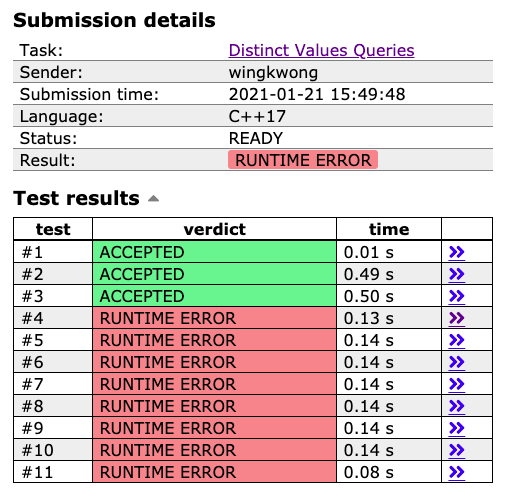
The reason is that each element can go up to 10 ^ 9. We cannot use frequency array for that. We also cannot use ``unordered_map`` as it will time out due to high constant factor. Therefore, an alternative is to use coordinate compression to map the large values to smaller one in the range [1, N] as N at most can be 2 * 10 ^ 5.
```cpp
int compressed = 1;
map compress;
REPN(i, n) {
// read the input
cin >> x[i];
// find the compressed value -> update x[i]
if(compress.find(x[i]) != compress.end()) x[i] = compress[x[i]];
// not found -> compress it and update x[i]
else compress[x[i]] = compressed, x[i] = compressed++;
}
```
Now [the revised solution](https://cses.fi/paste/d8a09d857905de4a182310/) gives you 4 TIME LIMIT EXCEED verdicts.
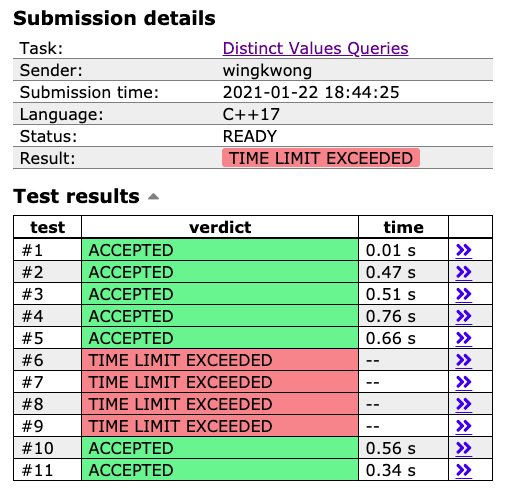
Let's rethink of the time complexity. When we sort all the queries, it will take O(QlogQ). For add(x) and remove(x), let the block size be S, it takes O((N / S) * N) calls for all blocks. If S is around sqrt(N), it takes O((N + Q) * sqrt(N)) in total. The solution can be all passed by changing the block_size to 555 and even more. Therefore, we can conclude that S = sqrt(N) doesn't always give you the best runtime. Moreover, we should also use ``const`` to define the block size instead of computing it in runtime as division by constants is optimized by the compliers. Is there a way to achieve a faster sorting? Yes. We can do it in O(N * sqrt(Q)) with [Hilbert Curve](https://en.wikipedia.org/wiki/Hilbert_curve).
## Solution 2 - Using Mo's Algorithm with Hilbert Curve
Hilbert Curve is a continuous fractal space-filling curve. Here's some examples.
Hilbert Curve with order = 1
```
|__|
```
Hilbert Curve with order = 2
```
__ __
__| |__
| __ |
|__| |__|
```
Hilbert Curve with order = 3
```
__ __ __ __
|__| __| |__ |__|
__ |__ __| __
| |__ __| |__ __| |
|__ __ __ __ __|
__| |__ __| |__
| __ | | __ |
|__| |__| |__| |__|
```
For each order N > 1, it traces out a miniature order N - 1, connecting from the end of the mini curve in the lower-left to the start of the mini curve in the upper-left and from the upper-right down to the lower-right and flip the quadrant to make the connection shorter. The pattern continues like that for higher orders. If we have a point about the halfway in the frequency line in Snake Curve, the locations of the point can be different wildly as N increases. However, with Hilbert Curve, the given point moves around less and less as N increases.
Therefore, we can revise our mo struct and the sorting compartor using Hilbert Order.
```cpp
struct mo {
int idx, left, right;
int64_t ord;
void set(int i, int l, int r) {
idx = i, left = l, right = r, ord = hilbert_order(l, r, 21, 0);
}
};
inline bool operator<(const mo &a, const mo &b) {
return a.ord < b.ord;
}
```
Here's the implementation of Hilbert Order function.
```cpp
inline int64_t hilbert_order(int x, int y, int pow, int rotate) {
if (pow == 0) return 0;
int hpow = 1 << (pow - 1);
int seg = (x < hpow) ? ( (y < hpow) ? 0 : 3 ) : ( (y < hpow) ? 1 : 2 );
seg = (seg + rotate) & 3;
const int rotate_delta[4] = {3, 0, 0, 1};
int nx = x & (x ^ hpow), ny = y & (y ^ hpow);
int nrot = (rotate + rotate_delta[seg]) & 3;
int64_t sub_square_size = int64_t(1) << (2 * pow - 2);
int64_t ans = seg * sub_square_size, add = hilbert_order(nx, ny, pow - 1, nrot);
ans += (seg == 1 || seg == 2) ? add : (sub_square_size - add - 1);
return ans;
}
```
We can see that [the final solution](https://cses.fi/paste/c16a9e1ae75872c6183147/) can pass all the test cases. With such technique, it works faster than the previous version, especially when N >> Q. Supposing we have a matrix with size 2 ^ k * 2 ^ k, if we divide it onto squares with size 2 ^ k - l * 2 ^ k - l, we need O(2 ^ k - l) time to travel between adjacent squares. We can process all queries in O(Q * 2 ^ k - l) = O(Q * N / sqrt(Q)) = O(N * sqrt(Q)).
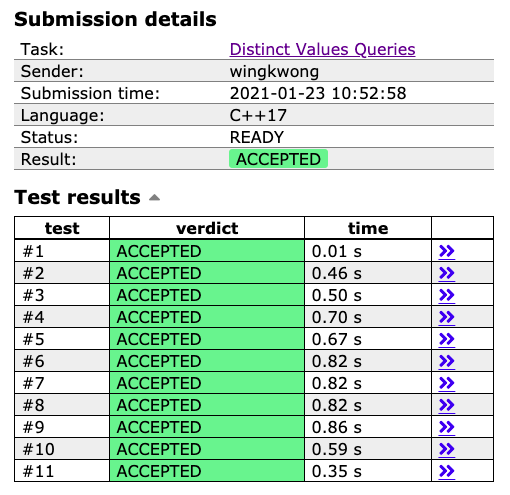
At the end, it took me 74 attmepts to find out the most optimized solution.

## Conclusion
We can solve this problem using Mo's algorithm because it is an offline algorithm as we don't need to update the elements or the execution order of queries. We can utilize Hilbert Curve to speed up the program. It can also be solved using Segment Tree.

Monday, 18 January 2021
Construct Quad Tree
A quadtree is a tree data structure in which each internal node has exactly four children.
Given a n * n matrix grid of 0's and 1's only. We want to represent the grid with a Quad-Tree.
Return the root of the Quad-Tree representing the grid.
Notice that you can assign the value of a node to True or False when isLeaf is False, and both are accepted in the answer.
Definition for a QuadTree node.
```cpp
class Node {
public:
bool val;
bool isLeaf;
Node* topLeft;
Node* topRight;
Node* bottomLeft;
Node* bottomRight;
Node() {
val = false;
isLeaf = false;
topLeft = NULL;
topRight = NULL;
bottomLeft = NULL;
bottomRight = NULL;
}
Node(bool _val, bool _isLeaf) {
val = _val;
isLeaf = _isLeaf;
topLeft = NULL;
topRight = NULL;
bottomLeft = NULL;
bottomRight = NULL;
}
Node(bool _val, bool _isLeaf, Node* _topLeft, Node* _topRight, Node* _bottomLeft, Node* _bottomRight) {
val = _val;
isLeaf = _isLeaf;
topLeft = _topLeft;
topRight = _topRight;
bottomLeft = _bottomLeft;
bottomRight = _bottomRight;
}
};
```
We can construct a Quad-Tree from a two-dimensional area using the following steps:
If the current grid has the same value (i.e all 1's or all 0's) set isLeaf True and set val to the value of the grid and set the four children to Null and stop.
If the current grid has different values, set isLeaf to False and set val to any value and divide the current grid into four sub-grids as shown in the photo.
Recurse for each of the children with the proper sub-grid.
If you want to know more about the Quad-Tree, you can refer to the wiki.
Quad-Tree format:
The output represents the serialized format of a Quad-Tree using level order traversal, where null signifies a path terminator where no node exists below.
It is very similar to the serialization of the binary tree. The only difference is that the node is represented as a list [isLeaf, val].
If the value of isLeaf or val is True we represent it as 1 in the list [isLeaf, val] and if the value of isLeaf or val is False we represent it as 0.
Example:
```
Input: grid = [[0,1],[1,0]]
Output: [[0,1],[1,0],[1,1],[1,1],[1,0]]
```
Solution:
Recursively divide the grid by four and check if it is the leaf and its value is same as the other three.
```
Node* construct(vector>& grid) {
int n = (int) grid.size();
return build(grid, 0, 0, n);
}
Node* build(vector>& grid, int i, int j, int n) {
if(n == 1) return new Node(grid[i][j], true);
Node* res = new Node(0, false,
build(grid, i, j, n / 2),
build(grid, i, j + n / 2, n / 2),
build(grid, i + n / 2, j, n / 2),
build(grid, i + n / 2, j + n / 2, n / 2));
if(
res->topLeft->isLeaf &&
res->topRight->isLeaf &&
res->bottomLeft->isLeaf &&
res->bottomRight->isLeaf &&
res->topLeft->val == res->topRight->val &&
res->topLeft->val == res->bottomLeft->val &&
res->topLeft->val == res->bottomRight->val
) {
res->val = res->topLeft->val;
res->isLeaf = true;
delete res->topLeft;
delete res->topRight;
delete res->bottomLeft;
delete res->bottomRight;
res->topLeft = NULL;
res->topRight = NULL;
res->bottomLeft = NULL;
res->bottomRight = NULL;
}
return res;
}
```
Sunday, 3 January 2021
AtCoder - 167D. Teleporter
You can practice the problem [here](https://atcoder.jp/contests/abc167/tasks/abc167_d).
## Problem statement
The Kingdom of Takahashi has N towns, numbered 1 through N.
There is one teleporter in each town. The teleporter in Town i (1 <= i <= N) sends you to Town A[i].
Takahashi, the king, loves the positive integer K. The selfish king wonders what town he will be in if he starts at Town 1 and uses a teleporter exactly K times from there.
Help the king by writing a program that answers this question.
## Sample Input 1
```
4 5
3 2 4 1
```
## Sample Output 1
```
4
```
## Sample Input 2
```
6 727202214173249351
6 5 2 5 3 2
```
## Sample Output 2
```
2
```
## Solution 1: Math
If you take a look at the sample input 2, we can see that there is no way to traverse k times by listing out the travel. We can easily obverse the pattern the loop starts at a certain point.
Example:
```
6 5 2 5 3 2
1 -> 6 -> 2 -> 5 -> 3 -> 2 -> 5 -> 3 -> 2 -> 5 ....
```
Starting from the third step, it starts the loop 2 -> 5 -> 3.
We can first create a map to store the index (0-based) and the value.
```cpp
m[i] = a[i]
```
Then we can find how many steps we need to make before entering the loop, let's say ``c[i]``, and how many steps to reach the first duplicate element, let's say ``step``.
```
bool duplicate = false;
ll i = 0, step = 0, kk = k;
while(!duplicate && kk){
step++; // step is used to find out when a town has been visited
if(d[i] == 1){
// if it is visited before, that is the start of the loop
duplicate = true;
continue;
}
d[i] = 1; // set the current i to 1, in other word, this has been visited
c[i] = step; // we need to store the step to another map because we need to calculate from where the looping starts
i = m[i] - 1; // -1 because it s 0 based
kk--; // monitor if it s out of boundary
}
```
We can calculate how many times we need to teleport from the repeating pattern as we know the length of the repeating pattern till k ``k - c[i]``, and the length of the repeating pattern ``step - c[i]``.
```
6 5 2 5 3 2
1 -> 6 -> 2 -> 5 -> 3 -> 2 -> 5 -> 3 -> 2 -> 5 ....
x x
|-----------step---------|
|--------------k-c[i]---------------- ....
|---c[i]--|
|------------------------k--------------------- ....
```
It performs only if it is not out of boundary.
```cpp
if(kk){
ll r = (k - c[i]) % (step - c[i]);
while(r >= 0){
i = m[i] - 1;
r--;
}
}
OUT(i + 1);
```
## Solution 2: Binary Lifting
After half a year, I came up with another solution using Binary Lifting which is a technique used to find the k-th ancestor of any node in a tree in O(logn). You can use it to find out Lowest Common Ancestor(LCA) as well.
We know the ``k`` can go up to 10 ^ 18, which means we only need around 60 nodes (log2(10 ^ 18)).
```cpp
const int mxN = 200005;
const int mxNode = 60; // ~ log2(k)
int up[mxN][mxNode];
```
First we need to preprecess the tree in O(nlogn) using dynamic programming.
```cpp
void binary_lifting() {
for(int i = 1; i < mxNode; i++) {
for(int u = 0; u < mxN; u++) {
up[u][i] = up[up[u][i - 1]][i - 1];
}
}
}
```
Then we can easily find the k-th ancestor of any node in a tree in O(logn). In this case, we start from node 0.
```cpp
int kth_ancestor(ll u, ll k) {
for(int i = 0; i < mxNode; i++) {
if(k & (1LL << i)) u = up[u][i];
}
return u;
}
```
The answer would be ``kth_ancestor(0, k) + 1``.
## Source Code
The full solution is avilable [here](https://github.com/wingkwong/competitive-programming/blob/master/atcoder/contests/abc167/D.cpp).
Thursday, 31 December 2020
What open-source projects have I contributed to Github in 2020?
Today is the last day of 2020, which means it is time to have my 2020 Github Rewind!
Last year I've had 1,775 contributions on Github and I got 4,104 contributions as of today. You can see my Github profile [here](https://github.com/wingkwong).

Let's go through what I've worked on one by one in an arbitrary order.
## vote4hk/warsinhk

[warsinhk](https://github.com/vote4hk/warsinhk) is a static website for [covid19.vote4.hk](covid19.vote4.hk). I've developed some components such as alert message boxes, datepicker, share buttons and etc, integreated react-i18next, did some bug fixing and revised the documentation.
## aws/aws-sam-cli
[aws-sam-cli](https://github.com/aws/aws-sam-cli) is a CLI tool to build, test, debug, and deploy Serverless applications using AWS SAM.

I've worked on a bug ticket with Jacob who is a senior software engineer at AWS. The bug was about the attribute ``Command.ScriptLocation`` not being updated for ``Glue::Job`` when running ``sam build`` because dot notations were not supported. At the beginning, my implementation was a bit complicated and Jacob suggested to use ``jmespath`` to handle the querying for nested attributes in JSON instead. The pull request was merged after 2-month discussion.
## wingkwong/hk-address-parser
[hk-address-parser](https://github.com/wingkwong/hk-address-parser) is an unofficial library for [Hong Kong Address Parser](https://g0vhk-io.github.io/HKAddressParser/#/), designed for Python applications.
The usage is pretty simple.
```
from hk_address_parser import AddressParser
# Single Query
address = AddressParser.parse( "Eaton Hotel, 380 Nathan Road, Jordan")
# Batch Query
addresses = AddressParser.parse(
[
"九龍觀塘海濱道 181號 9樓",
"九龍長沙灣道 303號長沙灣政府合署 12樓",
"九龍啟德協調道 3號工業貿易大樓 5樓",
"香港中環統一碼頭道 38號海港政府大樓 7樓",
"香港北角渣華道 333號北角政府合署 12樓1210-11室",
"九龍旺角聯運街 30號旺角政府合署 5樓 503室",
"九龍觀塘鯉魚門道 12號東九龍政府合署 7樓",
"九龍深水埗南昌邨南昌社區中心高座 3樓",
"九龍黃大仙龍翔道 138號龍翔辦公大樓 8樓 801室",
"新界沙田上禾輋路 1號沙田政府合署 7樓 708-714室",
"新界大埔墟鄉事會街 8號大埔綜合大樓 4樓",
"新界荃灣大河道 60號雅麗珊社區中心 3樓",
"新界屯門震寰路 16號大興政府合署 2樓 201室",
"新界元朗橋樂坊 2號元朗政府合署暨大橋街市 12樓"
]
```
Then you can call the [methods](https://github.com/wingkwong/hk-address-parser#methods) to get the corresponding info.
## cli/cli

[cli](https://github.com/cli/cli) is GitHub’s official command line tool written in Go. I've worked on the command ``gh gist create`` which is used to create a new Github gist with given contents. The feature has been released. For the usage, please check out the official documentation [here](https://cli.github.com/manuala/gh_gist_create).
## aws/copilot-cli

[copilot-cli](https://github.com/aws/copilot-cli) is a tool for developers to build, release and operate production ready containerized applications on Amazon ECS and AWS Fargate.
I was responsible for a few bug fixing tickets and a feature adding an optional env flag to the command ``app delete`` with test cases.
## wingkwong/k8sgen

[k8sgen](https://github.com/wingkwong/k8sgen), written in Go, is an utility which is designed to guide users to build their Kubernetes resources in an interactive CLI. At that time I was learning k8s and drilling down into the details of its internal designs. It was an experimental project.
```bash
k8sgen jumpstart
_ ___
| | _( _ ) ___ __ _ ___ _ __
| |/ / _ \/ __|/ _ |/ _ | |_ \
| | (_) \__ | (_| | __| | | |
|_|\_\___/|___/\__, |\___|_| |_|
|___/
? What kind of object you want to create? [Use arrows to move, type to filter]
ClusterRole
ClusterRoleBinding
Configmap
> Deployment
Job
Namespace
PodDisruptionBudget
PriorityClass
Quota
Role
RoleBinding
Secret
Service
ServiceAccount
? What deployment you want to name? my-deployment
? What image you want to name to run? busybox
? Please select an output format yaml
json
> yaml
? What directory you want to save? /home/wingkwong/deployment.yaml
```
Result:
```
apiVersion: apps/v1
kind: Deployment
metadata:
creationTimestamp: null
labels:
app: my-deployment
name: my-deployment
spec:
replicas: 1
selector:
matchLabels:
app: my-deployment
strategy: {}
template:
metadata:
creationTimestamp: null
labels:
app: my-deployment
spec:
containers:
- image: busybox
name: busybox
resources: {}
status: {}
```
## cortexlabs/cortex

[Cortex](https://github.com/cortexlabs/cortex) is an open source platform for large-scale inference workloads.
I added a feature to support ``.cortexignore`` file to exclude files/directories from cortex project zip and also updated AWS resource metadata.
## wingkwong/react-quiz-component
[react-quiz-component](https://github.com/wingkwong/react-quiz-component) is a ReactJS component allowing users to attempt a quiz. I've added some new features and worked on some bug fixing tickets. Currently it got 10K+ downloads in NPM.
## alexellis/k3sup

[k3sup](https://github.com/alexellis/k3sup) is a light-weight utility to get from zero to KUBECONFIG with k3s on any local or remote VM. All you need is ssh access and the k3sup binary to get kubectl access immediately.
I've made a pull request with the changes to add ``app info`` sub-command to show post-install instructions for an app and the app homepage link, so that users don't have to unnecessarily install again to see them, which was the only way till now to see post install instructions. The changes were implemented for nginx-ingress, cert-manager, metrics-server, tiller, linkerd, cron-connector, kafka-connector, minio, postgresql, kubernetes-dashboard, istio, and crossplane commands.
## inlets/inlets & inlets/inletsctl

[inlets](https://github.com/inlets/inlets) is a Cloud Native Tunnel written in Go and [inletsctl](https://github.com/inlets/inletsctl) creates inlets tunnel servers in the cloud.
The same bug was found in both repository. When running ``get.sh``, the program will fail if the target folder contains a space. Therefore I made the same fix to both repository. The fix was simple enough - just added several double quotes.
## My Self-Learning Playgrounds
I learn something new by doing when I feel bored. Here's the list.
- [aws-playground](https://github.com/wingkwong/aws-playground)
- [azure-playground](https://github.com/wingkwong/azure-playground)
- [gcp-playground](https://github.com/wingkwong/gcp-playground)
- [qsharp-playground](https://github.com/wingkwong/qsharp-playground)
- [nlp-playground](https://github.com/wingkwong/nlp-playground)
- [deno-playground](https://github.com/wingkwong/deno-playground)
- [gRPC-playground](https://github.com/wingkwong/gRPC-playground)
- [argocd-playground](https://github.com/wingkwong/argocd-playground)
- [skaffold-playground](https://github.com/wingkwong/skaffold-playground)
- [traefik-playground](https://github.com/wingkwong/traefik-playground)
- [lxd-playground](https://github.com/wingkwong/lxd-playground)
## wingkwong/competitive-programming
[competitive-programming](https://github.com/wingkwong/competitive-programming) contains CP solutions (mostly written in C++) from different OJs and contest sites with explanations. I believe most of the commits come from this repository as I've solved quite a lot of problems this year.

Competitive programming is a mind sport for programmers to solve mathematical or logical problems. I started my CP journey in 2014 and I had a chance to participant in ACM-HK Collegiate Programming Contest in 2015. I took a long break since then. Most of the people practice lots of CP problems just to get into FANNG companies but I only treat it as a hobby.
## Conclusion
In 2020, I mainly worked on CLI projects in Go, practiced 1000+ CP problems in C++, and learned cloud native stuff. In the next year, I believe I'll focus on advanced algorithms. Probably I'll try to use different programming languages to solve the CP problems to sharpen my programming skills.
Wednesday, 30 December 2020
Finding Longest Palindrome in O(n) Using Manacher's Algorithm
You can practice the problem [here](https://cses.fi/problemset/task/1111/).
Given a string, your task is to determine the longest palindromic substring of the string. For example, the longest palindrome in aybabtu is bab.
A palindrome here is a string which reads the same backward as forward. We can use functions like ``reverse`` to check if the given string is a palindrome or not.
```cpp
bool is_palindrome(string s) {
string t = s;
reverse(t.begin(), t.end());
return s == t;
}
```
Or we can use two pointers.
```cpp
bool is_palindrome(string s) {
int l = 0, r = (int) s.size() - 1;
while(l < r) {
if(s[l] != s[r]) return false;
else l++, r--;
}
return true;
}
```
The first approach is brute force.
```cpp
int n = (int) s.size(), start = 0, mx_len = 1;
REP(i, n) {
REP(j, i) {
int ok = 1;
REP(k, (j - i + 1) / 2) {
if(s[i + k] != s[j - k]) ok = 0;
}
if(ok && (j - i + 1) > mx_len) {
start = i;
mx_len = j - i + 1;
}
}
}
OUT(s.substr(start, mx_len));
```
However, the time complexity for this solution is O(n ^ 3) because we need three nested loops to find the longest palindromic substring. It only works when n is really small.
The second approach is dynamic programming. The time complexity can be further reduced to O(n ^ 2).
We use dp[i][j] to indicate if s[i] .. s[j] is a palindrome or not. Let's think about the transitions.
1. If i == j, that means s[i] == s[j], a single character is a palindrome. Example: a.
2. If i + 1 == j and s[i] == s[j], then s[i] .. s[j] is a palindrome. Example: aa.
3. If dp[i + 1][j - 1] and s[i] == s[j], then s[i] .. s[j] is a palindrome. Example: abba.
As we can see, dp[i + 1][j] needs to be calculated before d[i][j]. Therefore, we iterate i from n - 1 to 0 and j from i + 1 to n.
```cpp
int n = (int) s.size();
vvi dp(n, vi(n, 0));
string ans;
int start = 0, len = 1;
REP(i, n) dp[i][i] = 1;
FORD(i, n - 1, 0) {
FOR(j, i + 1, n) {
if(s[i] == s[j]) {
if(i + 1 == j || dp[i + 1][j - 1]) {
dp[i][j] = 1;
if(len < j - i + 1) {
start = i;
len = j - i + 1;
}
}
}
}
}
OUT(s.substr(start, len));
```
With dynamic programming, the time cplexity and auxiliary space are O(n ^ 2). However, we can solve the problem in linear time using Manacher's algorithm.
As a palindrome has a symmetric property at the center position, it could help us to reduce some unnecessary computations. If there is a palindrome of length N centered at position P, we can avoid the comparisions after position P as we already calculated longest palindromic substring at position before P. However, an even palidrome has two centers, which makes the calculate a little bit different than the one calculating for an odd palindrome.
Here's the implementation in C++.
```cpp
string manacher(string s) {
int n = (int) s.size();
// d1[i]: the number of palindromes accordingly with odd lengths with centers in the position i.
// d2[i]: the number of palindromes accordingly with even lengths with centers in the position i.
vector d1(n), d2(n);
int l1 = 0, r1 = -1, l2 = 0, r2 = -1, mx_len = 0, start = 0;
for (int i = 0; i < n; i++) {
// ----------------------
// calculate d1[i]
// ----------------------
int k = (i > r1) ? 1 : min(d1[l1 + r1 - i], r1 - i + 1);
while (0 <= i - k && i + k < n && s[i - k] == s[i + k]) k++;
d1[i] = k--;
if (i + k > r1) l1 = i - k, r1 = i + k;
if(d1[i] * 2 > mx_len) start = i - k, mx_len = d1[i] * 2 - 1;
// ----------------------
// calculate d2[i]
// ----------------------
k = (i > r2) ? 0 : min(d2[l2 + r2 - i + 1], r2 - i + 1);
while (0 <= i - k - 1 && i + k < n && s[i - k - 1] == s[i + k]) k++;
d2[i] = k--;
if (i + k > r2) l2 = i - k - 1, r2 = i + k;
if(d2[i] * 2 > mx_len) start = i - k - 1, mx_len = d2[i] * 2;
}
// return the longest palindrome
return s.substr(start, mx_len);
}
```
If you want to count how many palindromic substrings in the given string, simply sum d1[i] and d2[i] where i = 0 .. n - 1.
```cpp
int cnt = 0;
for(int i = 0; i < n; i++) cnt += d1[i] + d2[i];
```
This problem can also be solved using fast LCA in O(n) or String Hashing O(nlogn). These methods will not be discussed in this post.
You can find the whole solution [here](https://github.com/wingkwong/competitive-programming/blob/09531f2fbfbf03393ba3e744cb77858134463e29/cses/string-algorithms/1111-longest-palindrome.cpp).
Subscribe to:
Posts (Atom)